
Construction Apprenticeship: Paid Training for a Skilled, Government-Supported Trade
Earn While You Learn | Government-Supported Training | $20.71–$34.52/hr | No Prior Experience Required
The construction trade remains one of the most essential and high-demand skilled professions, supporting infrastructure, residential and commercial building, utilities, and environmental projects. Through Department of Labor–supported registered construction apprenticeship programs, individuals can enter the field No need to worry about tuition fees, gain real paid work experience, and work toward nationally recognized certifications that open the door to stable, well-paid employment.
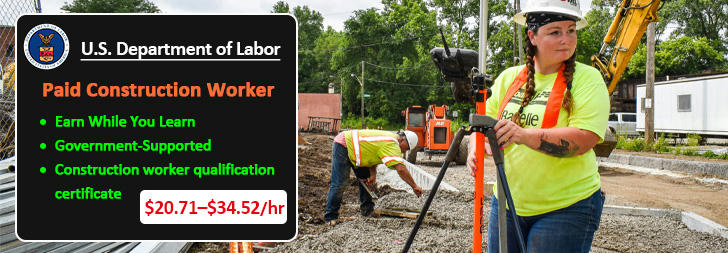
During the paid training period, hourly wages typically range from $20.71 to $34.52 per hour, with increases as apprentices gain experience and progress through the program.
What Is a Construction Apprenticeship?
A construction apprenticeship is a Department of Labor–supported, registered training program that blends paid on-the-job training with classroom instruction. Apprentices are employed by construction contractors and work under the supervision of experienced professionals while attending classes that build foundational knowledge, advanced trade skills, and safety awareness.
Key highlights of apprenticeship programs include:
- Paid employment, with wage increases as skills develop
- Structured hands-on training under seasoned mentors
- Related classroom instruction supporting practical skill development
- Support in obtaining industry-recognized credentials upon completion
Why Choose an Apprenticeship in Construction?
Becoming a qualified construction worker through a Department of Labor–supported apprenticeship provides tangible advantages:
Earn While You Learn
Apprentices receive a salary throughout their training, with scheduled wage increases as expertise grows.
No Student Loan Burden
Because apprentices are paid for their work, there’s no need to take on large tuition debt.
Industry-Recognized Credential
Upon successful completion of the apprenticeship, apprentices receive assistance in obtaining a recognized construction credential.
Strong Job Prospects and Security
Skilled construction workers are essential across infrastructure, utilities, environmental remediation, and building trades — roles that offer job security and advancement over a long career.
How Apprenticeship Training Works
Most construction apprenticeship programs last approximately 2 years, combining 4000 hours of on-the-job training with structured classroom instruction:
| Component | What It Involves |
|---|---|
| On-the-Job Training | 4000 hours of paid, supervised hands-on work |
| Classroom Instruction | Structured learning on technical skills, safety, and industry standards |
| Mentorship | Guidance and supervision from experienced professionals |
| Credential | Certificate of completion and assistance with industry credentials |
This structure allows apprentices to Earn While You Learn, gaining practical experience and academic knowledge simultaneously.
Who Is This Suitable For?
Construction apprenticeships are designed for a wide range of participants:
- Those entering the workforce with a high school diploma or GED
- Individuals seeking a skilled trade without four-year college tuition
- Career changers pursuing long-term, practical careers
- Adults with interest in construction, hands-on work, or project environments
General requirements include:
- Minimum age of 18
- High school diploma or GED
- No prior construction experience required
These programs are entry points into a high-demand construction career, supported by the Department of Labor.
Career Path and Earnings Potential
Upon completing an apprenticeship and obtaining journeyman or equivalent status, construction professionals are in high demand across many sectors. Opportunities include:
- Residential and commercial building projects
- Infrastructure development and maintenance
- Utility installation and upgrades
- Environmental construction support roles
- Specialized construction tasks with further certifications
Wages for certified construction workers are competitive, with many earning well above average, and further growth possible through specialization or union pathways.
Age Groups and How Apprenticeships Fit Different Life Stages
| Age Range | Typical Profile | Why a Construction Apprenticeship Works |
|---|---|---|
| 18–24 | School leavers or early career entrants | Hands-on training without college debt; early entry into a skilled profession |
| 25–34 | Career builders or trade switchers | Earn income while retraining; strong long-term earning potential |
| 35–44 | Mid-career changers | Practical skills with clear progression and job security |
| 45–54 | Stability-focused workers | Structured learning with predictable wages and demand-driven employment |
| 55+ | Late-career learners | Skill-based work with ongoing demand, opportunities in maintenance and specialty roles |
Apprenticeships focus on skill acquisition rather than academic background, allowing motivated individuals at different life stages to build a sustainable career through Earn While You Learn and recognized certification.
How to Get Started
- Search for government-supported construction apprenticeship openings through Apprenticeship.gov or local workforce partners.
- Prepare documentation such as a diploma or GED and valid ID.
- Apply during open enrollment periods with participating construction contractors.
- Complete interviews and assessments, if required.
- Begin paid on-the-job training and classroom instruction.
Apprenticeship Benefits at a Glance
- Earn While You Learn through paid training
- Department of Labor–supported program structure
- Industry-recognized credentials
- Clear advancement pathways
- Strong demand across construction sectors
Best Wishes
Registered construction apprenticeships provide a practical, well-paid pathway into a highly skilled profession, combining real-world work experience with formal training — all while Earn While You Learn and building a long-term career.